
RHS Level 2 Reading List (Units 1 & 2): Essential & Recommended Books for Exam Success
Use this reading list to prioritise your reading for the RHS Level 2 Certificate in the Principles of Plant Growth & Development (Units 1 and 2).
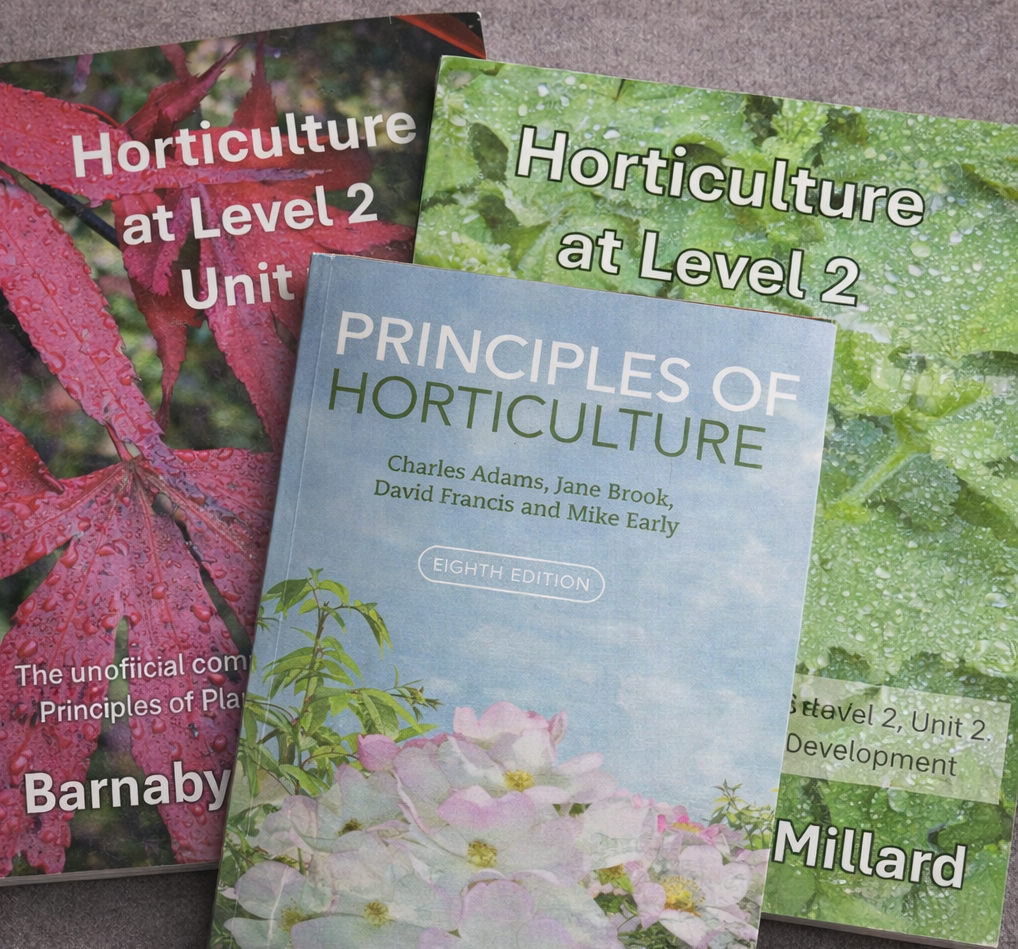
Garden Learners Tutor Note: This RHS Level 2 reading list focuses on the books that most directly support exam success for Units 1 and 2.
Important: You do not need to read every book on this page to pass RHS Level 2.
- If you only buy two books:
- 1) Principles of Horticulture
- 2) Horticulture at Level 2: Unit 1
- 3) Horticulture at Level 2: Unit 2
- 4) RHS Botany for Gardeners
- 5) How Plants Work
- 6) Essential Soil Science
- 7) The Gardeners’ Companion to Pests and Diseases
- 8) Latin for Gardeners
- 9) Companion to Wildlife Gardening
- 10) Wild Flowers
- 11) RHS A–Z Encyclopedia of Garden Plants
If you only buy two books:
- Horticulture at Level 2: Unit 1
- Horticulture at Level 2: Unit 2
Everything else is additional support, not required.
| Book | Essential or Support? | Best For | Buy First? |
|---|---|---|---|
| Horticulture at Level 2: Unit 1 (Barnaby Millard) | Essential | Full syllabus coverage for Unit 1 | Yes |
| Horticulture at Level 2: Unit 2 (Barnaby Millard) | Essential | Full syllabus coverage for Unit 2 | Yes |
| Principles of Horticulture (Charles Adams) | Strong Support | Core theory that underpins both units | If you want a deeper understanding |
| RHS Botany for Gardeners | Support | Clear plant science explanations and terminology | Optional |
| How Plants Work | Support | Understanding plant function and processes | Optional |
| Essential Soil Science | Support | Soil structure, drainage, texture, water movement | Optional (good for Unit 1 confidence) |
| The Gardeners’ Companion to Pests and Diseases | Support | Pest and disease identification | Optional |
| Latin for Gardeners | Support | Plant naming confidence | Optional |
| Companion to Wildlife Gardening | Support | Biodiversity and wildlife topics | Optional |
| Wild Flowers | Support | Recognising UK species | Optional |
| RHS A–Z Encyclopedia of Garden Plants | Reference | Large plant reference guide | Optional |
Core Reading (Essential Books for RHS Level 2)
1) Principles of Horticulture
Author: Charles Adams
Why it’s useful (RHS Level 2):
- A broad foundation text that supports both units.
- Helps link overlapping topics (e.g. soil → water → nutrition → plant health).
- Useful when you want one book that ties ideas together during revision.
2) Horticulture at Level 2: Unit 1
Author: Barnaby Millard
Why it’s useful (RHS Level 2):
- Written specifically for the RHS qualification and closely aligned to Unit 1 topics.
- Helps with revision of plant science basics, including plant structure and function, water and nutrient movement, soils, nutrition, and plant health.
- Best first reference when revising because the style and coverage match the course.
3) Horticulture at Level 2: Unit 2
Author: Barnaby Millard
Why it’s useful (RHS Level 2):
- Helps students get used to RHS phrasing and expectations, which supports exam technique.g
- Directly supports Unit 2 learning around biodiversity, sustainability, plant selection, and horticulture in society.
Recommended Reading
4) RHS Botany for Gardeners
Organisation/Author: Royal Horticultural Society/Geoff Hodge
Why it’s useful (RHS Level 2):
- Clear explanations of plant structure and processes using correct terminology.
- Helps students answer questions confidently on roots, stems, leaves, and core plant science.
- Particularly useful for getting accurate wording in short answers.
5) How Plants Work
Edited by: Stephen Blackmore
Why it’s useful (RHS Level 2):
- Strong support for understanding how plants function rather than memorising facts.
- Helpful for Unit 1 “explain”-style questions about water relations, nutrient uptake, and plant responses to conditions.
6) Essential Soil Science
Authors: Mark R. Ashman & Geeta Puri
Why it’s useful (RHS Level 2):
- Written as an accessible introduction to soil science, making it well-suited to Level 2 study.
- Covers soil texture and structure, organic matter, water movement and drainage, and basic nutrient behaviour at the right depth for RHS exams.
- Easier for students to translate into clear, descriptive and explanatory answers than more advanced soil textbooks.
- Works well alongside the RHS Unit 1 book without overwhelming learners.
7) The Gardeners’ Companion to Pests and Diseases
Author/Organisation: Royal Botanic Gardens, Kew
Why it’s useful (RHS Level 2):
- Practical reference for identifying common pests/diseases and understanding symptoms.
- Supports plant health across both units and helps students link symptom → cause → control.
8) Latin for Gardeners
Author: Lorraine Harrison
Why it’s useful (RHS Level 2):
- Helps decode scientific names and reduces confusion with plant terminology.
- Useful for confidence when reading exam questions and learning plant examples.
9) Companion to Wildlife Gardening
Author/Organisation: Royal Horticultural Society (RHS)
Why it’s useful (RHS Level 2):
- Supports Unit 2 biodiversity and habitat topics.
- Gives practical examples students can use in applied answers.
10) Wild Flowers
Author: Carol Klein
Why it’s useful (RHS Level 2):
- Builds confidence with recognising common wild and garden plants using clear visual cues.
- Supports Unit 2 background understanding of biodiversity and plants in managed and semi-natural settings.
- Useful for general plant familiarity rather than detailed identification required for exams.
11) RHS A–Z Encyclopedia of Garden Plants
Author/Organisation: Royal Horticultural Society (RHS)
Why it’s useful (RHS Level 2):
- Excellent plant reference for checking plant names, families, and basic characteristics.
- Helps students build confidence with plant examples for Unit 2 style answers.
- Useful long-term reference for anyone working or studying in horticulture.
- Not exam-essential, but very helpful for building broader plant knowledge.